Books and Articles
ACTING ON IMPULSE: Reclaiming the Stanislavski Approach. A practical workbook for actors.
 John wrote this book between 2005-07 and it was published in October, 2007, by Methuen
Drama. It is the culmination of his work as actor, director and teacher during the last four decades. The Foreword is by acclaimed actor/director, Samuel West.
John wrote this book between 2005-07 and it was published in October, 2007, by Methuen
Drama. It is the culmination of his work as actor, director and teacher during the last four decades. The Foreword is by acclaimed actor/director, Samuel West.
Acting as organic experience or representational pretence? Stanislavski was the first to outline a systematic approach for using human experience to create truthful acting. While this is paid much lip service, it is often rejected and misunderstood, or misapplied and distorted.
John Gillett offers, not a brief and partial summary, but a comprehensive and lucid step-by-step account of Stanislavski’s whole approach from the actor’s training to final performance. It is for actors from an actor’s point of view. He draws on the major books - An Actor Prepares, Building a Character and Creating a Role - and records of Stanislavski’s directing process and final studio classes. The book unites theory and practice by providing accessible, practical examples and exercises as an integrated part of each subject.
Stanislavski’s approach is enhanced and clarified by relating to it the imaginative work of his ‘most brilliant pupil’, Michael Chekhov, often misrepresented as opposing Stanislavski, but, in fact, rooted in his artistic aims and premises while developing his own understanding and techniques. The work of other modern practitioners —Uta Hagen, Maly Drama Theatre, Stella Adler, Sanford Meisner, Lee Strasberg, David Mamet—is also considered, revealing how it supports and augments or distorts and opposes Stanislavski.
In addition, the book places Stanislavski in the often unfavourable context of the British entertainment industry and looks at alternative ways of working inspired by European ensemble companies and more generous arts funding. Biographies of key practitioners and a glossary of terminology help to make this an essential practical and educational resource for any student or practitioner of acting.
Practitioner reviews for Acting On Impulse - Reclaiming the Stanislavski Approach
Marina Caldarone, co-author of "ACTIONS", The Actor's Thesaurus:
"John Gillett's book will give you all the tools you need in your 'Acting' kit. It's as precise as it is playful, and both the theory and practical exercises will give you a process whereby you can create truthfully. It also sets the record straight in terms of what Stanislavski was actually about. Its invaluable. "
Samuel West, actor, director:
"Provides support and inspiration to the actor. A manual full of enabling, easing exercises - it will enable you to analyse any scene. The cry of the actor at sea 'I don't know what I'm doing' should, with this book, become a thing of the past."
Edda Sharpe, co-author of "HOW TO DO ACCENTS" and "HOW TO DO Standard English ACCENTS":
"This is a truly astonishing book. If an actor was to have just one book on the process of acting on their shelf it should be this one. The author manages to combine real depth of knowledge and intellectual understanding with clear application of theory to practice. And somehow does this all in a book which is gripping! "
Simon Dunmore, Editor "Actor's Yearbook" :
"Contains all the important things that need to be said about learning to act in an extremely logical and sensible manner. On a number of occasions I have observed John Gillett put his approach into action - with superb results. Now he has put it all into one book - with great clarity. Not only that but he writes in such a compelling way. John Gillett has cut through the mystique that seems to abound in the world of acting in a clear, down to earth way."
David Thorpe, actor and teacher:
"Strange as it may seem, I've actually read very few books about acting, but yours is by far and away the best I've ever read. I cannot tell you how inspiring I've found it."
Annie Tyson, acting tutor at RADA and Drama Centre
"This is an excellent book - one of the best of its kind that I have read. John Gillett's book is way out in front in that it offers both scholarship and really sound practical strategies based on both research and most importantly, his own experience as an actor, teacher and director. It should be on essential reading lists for 1st year students on Acting Courses. It takes its place as a core text as it does not dress anything up in theorising but is a combination of inspiration and practicality.
This is not only an extremely insightful and practical book for actors but also a brave one. John Gillett is not afraid to set out his stall and the book goes far beyond simply correcting misunderstandings and distortions regarding Stanislavski's work. He makes an inspirational claim for the actor as someone necessary to society, and for the vital importance of the ensemble. A terrific combination of practicality and a call to arms!"
James F. Schlatter, University of Pennsylvania:
"A great teaching and learning resource, thorough in its analytical outline and precise and detailed in setting out a technical vocabulary . . . of value to actors, acting teachers at all levels, and professionals in the field. A potential acting teacher could use this text as a classroom guide and as an aid in structuring a very systematic curriculum covering even an entire year of study, and then leading on to introducing a strong, Stanislavski-based technique to student actors engaging in a rehearsal process.
Matt Peover, LAMDA trainer and theatre director:
"I'd recommend this book to anyone wanting an introduction to Stanislavski or Michael Chekhov or acting in general."
Kenneth N. Mitchell, University of Minnesota/Guthrie Theater BFA Actor Training Program:
. . a wonderful book
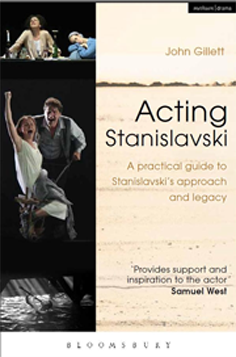
Acting Stanislavski - A practical guide to Stanislavski's approach and legacy
Stanislavski was the first to outline a systematic approach for using our experience, imagination and observation to create truthful acting. One hundred and fifty years after his birth, his approach is more widely embraced and taught throughout
the world - but is still often rejected, misunderstood and misapplied. John Gillett offers a clear and accessible but comprehensive and insightful step-by-step account of Stanislavski's whole approach from the actor's training to final
performance:
ease and focus
the nature of action, interaction and objectives
the imaginary reality, senses and feeling
active analysis of text
physical and vocal expression of character
the actor in the context of training and the industry.
He draws on Stanislavski's major books, in both English translations, and on records of his directing process and final studio classes, and demystifies terms and concepts. It is for actors from an actor's point of view, and offers many practical exercises and examples as an integrated part of each subject. Acting Stanislavski also elucidates Stanislavski's approach and creates an up-to-date overview by connecting with his legacy and successors, from Michael Chekhov to Meisner, Adler and Strasberg. This is a fully updated and revised new edition with added exercises and biographies, a new chapter on The character, and many new additions to other chapters and the Glossary: an essential practical and educational resource for any acting student, professional or teacher.
Click here for more information...

Voice into Acting - Integrating Voice and the Stanislavski approach
"I was fascinated to read Voice into Acting and the approach it presents for integrating vocal pedagogy with the acting process. The authors combine a depth of experience in voice teaching and in acting that enables them to write with authority, wisdom and clarity, making a valuable contribution to the field. Thorough, detailed, and very well organized. Strongly recommended."
DAVID CAREY, Voice and Text Director UK and USA, co-author of The Verbal Arts Workbook (Bloomsbury Methuen Drama, 2010)
How can actors bridge the gap between themselves and the text and action of a script, integrating fully their learned vocal skills? How do we make an imaginary world real, create the life of a role, and fully embody it vocally and physically so that voice and acting become one?
Christina Gutekunst and John Gillett unite their depth of experience in voice training and acting to create an integrated and comprehensive approach informed by Stanislavski and his successors - the acting approach widely taught to actors in drama schools throughout the world.
The authors create a step-by-step guide to explore how voice can: respond to our thoughts, senses, feelings, imagination and will
fully express language in content and form
communicate imaginary circumstances and human experience
transform to adapt to different roles
connect to a variety of audiences and spaces.
Featuring over fifty illustrations by German artist, Dany Heck, Voice into Acting is an essential manual for the actor seeking full vocal identity in characterization, and for the voice teacher open to new techniques, or an alternative approach, to harmonize with the actor's process.
A second edition came out in 2021 and this is the new link
Click here for more information...
Online reviews:
This is certainly one of the best voice books I have come across in decades. . . long awaited for - Silas MorrisonConnecting voice work to both the 'magic if' and 'playing the given circumstances' has been the Holy Grail of voice and acting coaches alike. This extraordinary book does it. These dedicated practitioners bring years of experience together in a detailed, thorough and inspiring way. I really can't say enough about it! Just buy it and start at the beginning... - Edda Sharpe
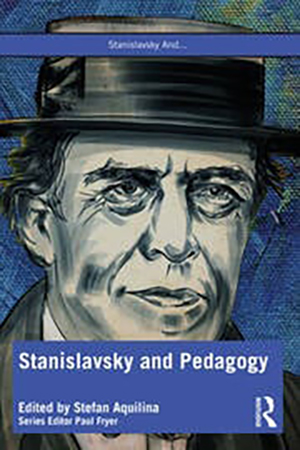
In 2024, John contributed to a new book, Stanislavsky and Pedagogy, published by Routledge and edited by Stefan Aquilina.
His chapter opens the book and defines his own teaching and directing process: Teaching Stanislavsky's Core Approach of Action, Imagination, and Experiencing : And Why it is still Relevant for Acting Students and Professionals.
Click here for more information...:
Below is an article John wrote for the Equity Journal in 2007
Maligned, misrepresented, misapplied and mystified: Stanislavski may have been one of the most revolutionary forces in acting and influenced practitioners such as Grotowski, Brook and Boal, but he’s often had a rough ride in Britain. I trained in the approach of Stanislavski and his pupil, Michael Chekhov, in the early seventies and met quite an array of attitudes to this when launching myself into the British industry: from outright hostility to what was dismissed as ‘method’, to a blase assumption that this approach had permeated the business and ‘everybody did it’ (for better or worse), from superficial lip service to its ideas to outright distortion and a very peculiarly English intellectualisation and de-radicalisation of what is essentially an imaginative and liberating process - a bit like putting Che Guevara on a T-shirt.
I believe the prevailing style of acting in Britain is still the Representational one of describing and illustrating the character from which the actor is distanced, and associated most perhaps with Coquelin in 19th century France and Olivier here; although we Brits, like any other actors, are capable of anything, and can produce wonderful Organic performances, experienced and truthful, based on a transformation of our own essential humanity and a recreation of recognisable human experience in imaginary circumstances. This universal process is at the heart of the Stanislavski approach. It’s about communicating this essential reality of experience whatever the form or genre of theatre, screen or radio in which we’re working and is not, as is often assumed, confined to so-called naturalism.Stanislavski’s early productions of Anton Chekhov’s plays at the Moscow Art Theatre might have contained naturalistic detail but the plays of Chekhov and other produced writers such as Shakespeare, Maeterlinck, Hamsun, and Gorki can hardly be described as naturalism. Other misconceptions abound. His acting approach is not primarily about emotional recall - this was the (mis)interpretation of Lee Strasberg and Method. Nor did he believe in cutting off the audience - the fourth wall is a means to focus actors on the action onstage to better communicate the depth and detail of its content to the audience, who will affect the actors onstage. His approach is distorted by the process of intellectually defining actions on lines in the first weeks of rehearsal, instead of engaging actors in interaction and exploring the action imaginatively. On an amusingly contradictory note, an older actor once told me that Stanislavski actors are always indulgent (a common criticism here), so I asked him why he acted. ‘Well, I just like to show off’, he replied! Stanislavski never said the actor actually becomes the character in life - rather, we use imagination to believe in ourselves as the character in the imaginary circumstances of the play while we’re performing so that a fresh, spontaneous, alive performance is created every time we do it.
I think this is what most actors would like to achieve. Unfortunately our training, professional experience, and the economics of the industry often militate against this. As students, we may face a pot-pourri of eclectic ideas, projects and directors’ concepts, and a lack of consistent and comprehensible acting process. As professional actors, we face short rehearsal periods and little involvement in the conception of a production - unlike actors in German state theatres or the great European ensembles like the St Petersburg Maly Drama Theatre and Stary Teatr in Poland. The government’s spending plans for the arts announced in October are better than feared but do not represent an increase in funding in real terms. The limited gains in production values made a few years ago were not experienced by theatres across the board and are not necessarily secure; and we are very far from achieving the desire expressed at Equity’s and the Directors’ Guild Ensemble Theatre Conference (2003) of gaining ensemble theatres in all major population centres. To value theatre in that artistic and social way requires a major shift in government thinking and our Theatre Funding Campaign should play a leading part in continuing to promote that.
Despite these obstacles a lot of Stanislavski’s approach can be absorbed and used. In the book, I aim to demystify and correct misconceptions by looking at his approach as a whole, from flawed beginnings to the workshops and writings of the ‘30s, focusing on the major books (An Actor Prepares, Building a Character,Creating a Role) and records of his directing practice and teaching. I write from an actor’s point of view for actors and outline a step-by-step, comprehensive account of a process from the first development of awareness, ease and focus to engagement of the will and feelings, physical and vocal embodiment of the role and through to final performance. I place practice alongside theory by presenting exercises within the main text. I also attempt to integrate the work and views of Michael Chekhov and other practitioners - for example, Uta Hagen, Lev Dodin, Sanford Meisner, David Mamet, and Strasberg - to reveal how they augment or contradict Stanislavski. As indicated earlier, I place the approach within the often unfavourable climate of a cash-starved British industry attached to frequently unadventurous ways of doing things. I look at alternative, collaborative ways of organising companies, rehearsals and performance so that we not only work as actors more fruitfully but also fulfil our social role as artists and connect more with our audiences; and, through a truthful and stimulating recreation of our human experience, enable people to grow in awareness and knowledge and find sustenance in an often dangerous and confusing world."
Articles written for Stanislavski Studies,produced by The Stanislavski Centre at Rose Bruford College and the St Petersburg Russian State Institute of Performing Arts and published by Routledge
Experiencing or pretending - are we getting to the core of Stanislavski's approach? (Issue 1, 2012)
John focuses on the fundamental choice actors, teachers, and directors have to make when confronted by the acting process. Do we experience, as advocated by Stanislavski, or do we pretend, as suggested by the representational approach? What does experiencing actually mean for actors and how does it relate to the brain's functioning and the actor's 'dual consciousness'? Can it apply to many forms of theatre? Do we really understand and encourage it in student and professional actors, and how much are we diverted by identification of Stanislavski with 'naturalism' and by economic and artistic pressures in the entertainment industry? John draws on other practitioners, such as Meisner, Adler and Michael Chekhov, to clarify Stanislavski's approach; and also examines the Teaching Stanislavski survey and questions how much, and to what degree of comprehensiveness, Stanislavski is actually taught in UK educational institutions, while making a case for his essential and enduring importance.
Read the full text here: tandfonline.com
In January 2013, John participated in a panel discussion at Pushkin House on Stanislavski and the legacy of Jean Benedetti, the Stanislavski scholar. This was part of the Stanislavski on Stage exhibition, and the discussions have now been transcribed and published in Stanislavski Studies, Volume 3/Issue 2, November 2015, under the title, Stanislavski on Stage:The Benedetti Legacy.Experiencing through the voice in Stanislavski's psycho-physical approach (Vol 4/Issue 2, 2016).
At the centre of Stanislavski's acting approach is the actor's connection with the imaginary circumstances and the action, a connection that is imaginatively experienced - not represented and illustrated - and is embodied vocally and physically to reach both 'the life of the human spirit of a role' and the audience. A key part of the action for Stanislavski is verbal action. Voice and speech, though, can be technically taught as skills separate from acting process. Language can be tackled from a static, literary perspective in rehearsals. Stanislavski viewed voice and speech not as ends in themselves but as flexible, changing responses to an imaginary, dynamic reality suggested by the text. The article examines how voice may be integrated within an organic acting process and be part of an embodied experience, and also draws on the views of Stanislavski-based practitioners and contemporary neuroscience and linguistics to validate Stanislavski's psycho-physical approach and later rehearsal methods. In the final part, it gives an insight into how to integrate understanding of acting process into vocal instruction, and how to integrate voice into acting exercises and text.In 2012, the Bloomsbury Revelations series re-published Stanislavski's An Actor Prepares, Building a Character, and Creating a Role. John was asked to write the Preface for the latter.